


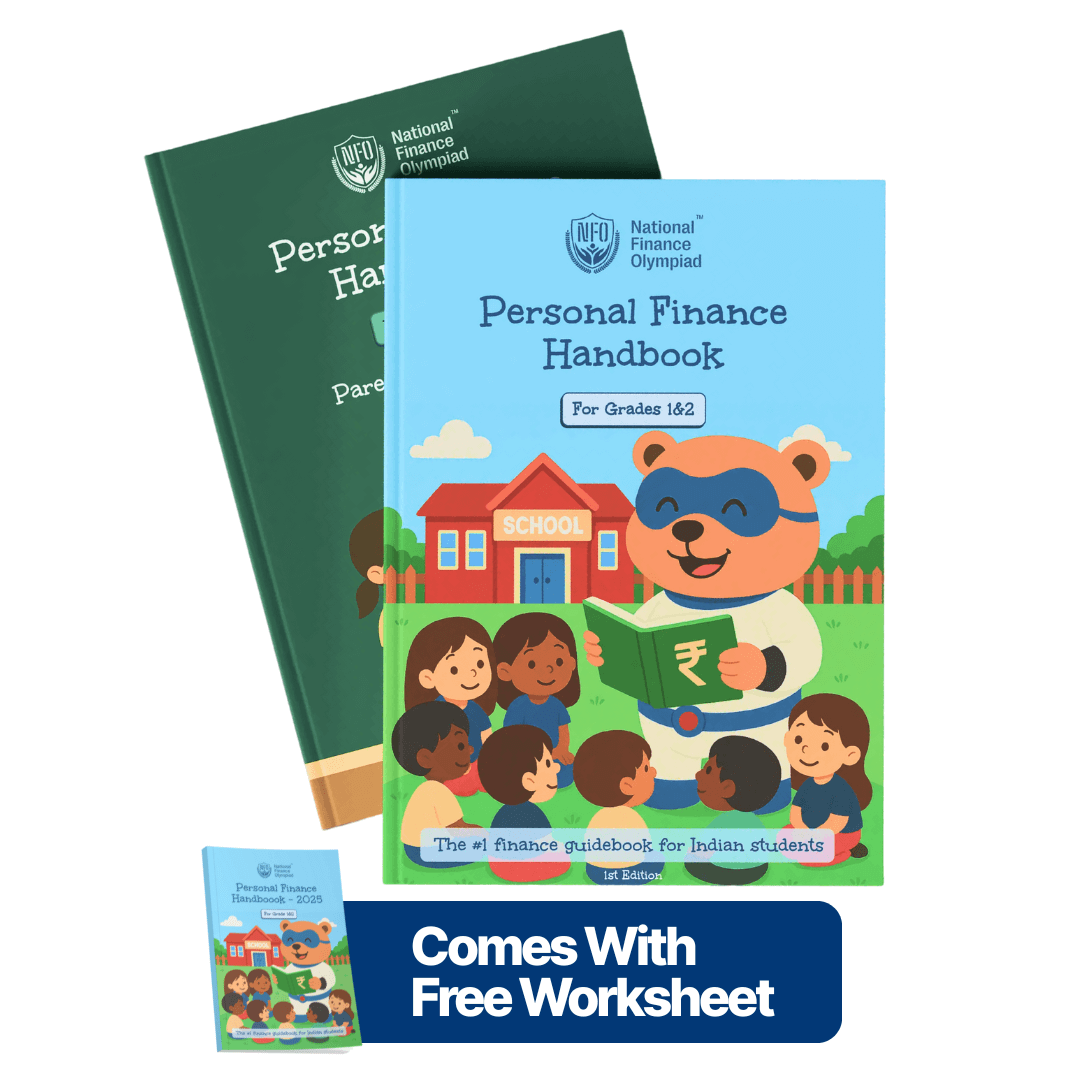
Explore the product images and details.
PRACTICAL FINANCE LEARNING
Grades 1-2nd Personal Finance Handbook
Practical money lessons for your next chapter.
Product availability and delivery confirmed at checkout
What Is It
Empower Your Child with Financial Mastery!
Why wait for life to teach your child about money
when you can equip them with the knowledge today?
In today’s world, children see money being used everywhere but do they truly understand what it means? The Personal Finance Handbook for Grades 1-2 is designed to give children a simple, joyful, and practical understanding of money.
Why You Need It
Crafted in collaboration with IIM professors and industry leaders, it’s more than a book, it’s a comprehensive guide to navigating the financial realities of tomorrow. From mastering investment principles and understanding compounding to analyzing debt and credit management, this handbook empowers teens to think critically and make informed financial decisions. 🚀
In today’s rapidly evolving world, financial literacy is not just a skill; it’s a necessity. This guide will inspire your teen to build confidence, take control of their financial journey, and develop habits that lead to long-term success. Give them the tools to thrive—because their future starts now! 🌟
Complete product details
Give Your Child a Head Start with Money Skills They'll Use for Life
Free Activity Book Included With Every Order
Why This Book Matters for Your Little One
Let's be honest – your child sees you paying for things every single day. At the store, online, with your phone. They're curious. They're asking questions. But do they really understand what money means?
The Personal Finance Handbook for Grades 1 & 2 gives children aged 6-8 their first proper introduction to money – in a way that's fun, colorful, and makes sense to their little minds.
This isn't just another textbook. It's 100+ pages of stories, games, and activities guided by Gebby the Bear that teach your child the money lessons you wish you'd learned at their age.
What Makes This Book Special?
✓ Built for Young Learners
Age-appropriate language and concepts that 6-8 year olds actually understand. No confusing jargon. Just simple, practical lessons that stick.
✓ Learn Together as a Family
Comes with a free Parent-Child Activity Bundle so you can make money conversations a natural part of family time. Turn everyday moments – like shopping trips or saving for a toy – into real learning experiences.
✓ Trusted by 500+ Schools Across India
This isn't some random book. The National Finance Olympiad has worked with hundreds of schools and helped thousands of students build financial confidence early.
✓ Makes Learning Actually Fun
Vibrant illustrations, relatable stories, and hands-on activities keep kids engaged. They won't even realize they're learning life skills.
8 Essential Money Lessons Your Child Will Master
Chapter 1: What is Money?
Understanding what money is, recognizing coins and notes, and seeing how it's used in daily life.
Chapter 2: Where Does Money Come From?
Learning that money is earned through effort and work – not magic. The difference between earning and receiving.
Chapter 3: Spending Money (Needs vs Wants)
The most important lesson: telling the difference between what they need and what they just want.
Chapter 4: Savings – Why and How?
Building the saving habit early with piggy banks, jars, and the satisfaction of reaching small goals.
Chapter 5: Setting Goals
Teaching patience and planning by saving toward something they really want.
Chapter 6: Budgeting
Making choices when money is limited – a skill they'll use their entire life.
Chapter 7: Bank Accounts
Understanding how banks keep money safe and why that piggy bank might need an upgrade someday.
Chapter 8: Digital Money & Money Safety
Introducing digital payments safely and teaching smart online money habits from day one.
What Parents Are Saying
Chetan Anand, Bengaluru
"The book's content is well-designed and it's wonderful that children are getting this unique opportunity to learn finance at such a young age."
What Your Child Will Actually Gain
By the time they finish this book, your child will:
-
Understand what money is and how it's used in real life
-
Know that money comes from earning and effort, not thin air
-
Be able to tell the difference between needs and wants when spending
-
Have started the habit of saving toward small goals
-
Know the basics of budgeting and making smart choices
-
Understand how banks keep money safe
-
Be introduced to digital money with safe habits
-
Feel confident making simple money decisions
These aren't just "nice to have" skills. This is the foundation for a financially secure future.
Who's Behind the National Finance Olympiad?
The NFO is India's leading platform for financial literacy among students. Founded by a passionate team of educators and financial professionals, they've empowered thousands of students across 500+ schools to become financially aware and confident decision-makers.
Backed by Industry Leaders:
-
Reeju Datta (Cofounder, Cashfree)
-
Soumya Kanti Purkayastha (Ex-CBO, Aakash Educational Services)
-
Professor Sankarshan Basu (Finance Professor, IIM Bangalore)
100% Risk-Free Purchase
✓ Cash on Delivery Available
No online payment required if you prefer COD.
✓ Secure Checkout
Your information is completely protected.
✓ 30,000+ Happy Families
Join thousands of parents who've already given their children this advantage.
4.8 - 1356 Reviews
★★★★★
Finally a book that teaches my daughter practical money skills she'll actually use in life!
★★★★★
Simple language, real examples, exactly what is needed to understand finances.
FREE SHIPPING ACROSS INDIA · TRUSTED BY 500+ SCHOOLS · 80,000+ COPY SOLD


Topics Covered


Sample Chapters


Trusted By 80,000+ Parents
Faqs
Got Questions?
What topics does the Personal Finance Handbook cover?
The handbook covers essential financial concepts including Money & Banking, Financial Planning, Investments, and Loans & Credits. Your child will learn about budgeting, digital payments, mutual funds, compound interest, insurance, and how to avoid debt—all explained with real-world examples and interactive tasks.
Is this book suitable for my child's grade level?
Yes! We offer grade-specific handbooks tailored to different learning levels. Each book is designed to match your child's comprehension ability while building a strong foundation in financial literacy. Simply select the grade that matches your child's current academic year.
How long does delivery take?
Standard delivery takes 5-7 business days across India. You'll receive a tracking number once your order is shipped. For metros and tier-1 cities, delivery is often faster, within 3-5 business days.
My child has no background in finance. Will they understand this book?
Absolutely! The handbook is written specifically for students with zero financial background. Complex concepts are broken down into simple language with relatable examples, illustrations, and step-by-step explanations that make learning finance easy and enjoyable.
Can I get a refund if the book doesn't meet my expectations?
Yes, we offer a 7-day return policy from the date of delivery. If you're not satisfied with the handbook, you can return it in its original condition for a full refund. Please refer to our Return & Refund Policy for complete details.
Is the content aligned with the Indian education system?
Yes, the handbook is fully aligned with the National Education Policy (NEP) 2020 and designed specifically for Indian students. All examples, case studies, and financial scenarios are relevant to the Indian context, covering topics like UPI, Indian banking, GST, and more.
How much time should my child spend with this book?
The handbook is designed for flexible self-paced learning. Your child can spend 20-30 minutes a day, or work through it on weekends. Most students complete the book in 4-6 weeks, but there's no rush—the goal is understanding, not speed.
Will my child need parental supervision to use this book?
Not necessarily. The book is designed for independent learning, though parental involvement can enhance the experience. We recommend parents review the concepts together with younger children (grades 6-8) and let older students (grades 9-12) explore more independently.
What Our Advisors Have To Say
-
"Understanding finance isn't just about balancing budgets; it's about mastering - opportunity, risk, and innovation. Initiatives like the National Finance Olympiad are instrumental in cultivating this essential skill set"
 Reeju Datta
Cofounder, Cashfree -
"Cultivating financial literacy among the youth is paramount for their future success. The NFO is equipping them with the tools they need to navigate the complexities of finance & build a secure future"
 Soumya Kanti Purkayastha
Ex-CBO Aakash Educational Services -
"By instilling finance and integrating practical financial education as a skill early on, we are equipping them with the knowledge to preserve their wealth & to create opportunities to create wealth."
 Professor Sankarshan Basu
Finance Professor, IIM Bangalore


